



Surge Group

Why Candidate Fail Interviews Despite Strong Experience


Recruitment
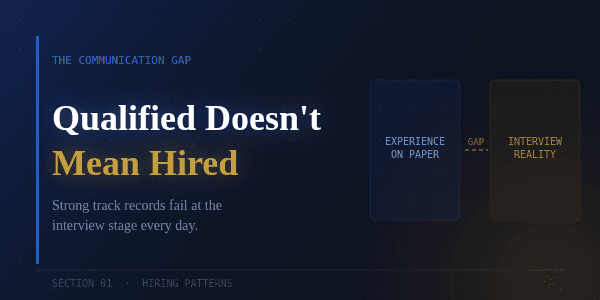
There’s a recurring pattern in hiring, particularly at the senior level. Highly qualified candidates with strong track records, credible networks, and relevant experience still fail to convert at the interview stage. On paper, they appear to be obvious hires. In the interview, that clarity often disappears. This is not a capability issue. It is a communication gap, and it remains one of the most overlooked factors in interview outcomes.
In today’s hiring market, especially across Web3, technology, and high-growth startups, interviews are no longer just a validation step. They are positioning exercises. Hiring managers are not only assessing what you have done, but how clearly you can connect your experience to the exact business problem they need to solve. Preparation now goes beyond reviewing your CV. It requires translating your experience into relevance, impact, and clear alignment with the role.
This is where many strong candidates fall short. They describe responsibilities instead of outcomes, rely on general experience instead of tailoring their answers, and focus heavily on past roles without clearly articulating future value. The substance is there, but the translation is not. The result is consistent. Candidates who are objectively qualified are perceived as good rather than essential, and in a market defined by faster decision cycles and stronger competition, that distinction matters.
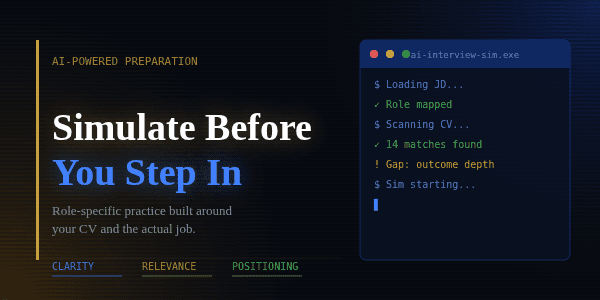
AI interview preparation tools are reshaping candidates approach interviews. Platforms like Perplexity AI allow candidates to simulate real interview scenarios before they step into the room. This is not generic preparation or recycled question banks. It is a role-specific practice built around the actual job and the candidate’s experience.
The process is straightforward. Candidates upload the job description, their CV, and relevant context about the company, product, or team. From there, the tool runs a realistic interview simulation aligned to that role. It generates likely questions, highlights gaps between experience and requirements, and suggests more precise ways to position answers. More importantly, it shifts the focus toward communicating outcomes and impact, rather than listing responsibilities.
This changes how preparation works. Instead of reviewing notes passively, candidates actively test how they communicate their experience. It becomes a process of refining clarity, improving structure, and strengthening delivery. By the time the interview happens, the narrative is already built, aligned to the role, and easier to communicate with confidence.
Why Communication Now Determines Interview Outcomes
Across hiring cycles, one pattern remains consistent. Candidates rarely lose offers because they lack experience. They lose offers because they fail to communicate relevance. In competitive processes, especially at senior level, the difference is not capability. It is clearly that capability is translated into value for the business.
Strong interview performance comes down to three elements. Clarity, the ability to explain your experience in a way that is immediately understood. Relevance, the ability to connect that experience directly to the company’s priorities. Positioning, the ability to present yourself as the solution to a specific need, not just another qualified candidate.
AI interview preparation tools strengthen all three. They help candidates move from explaining their background to clearly articulating why they are the right hire for a specific role. By simulating realistic interview scenarios, they push candidates to refine how they structure answers, prioritize information, and communicate impact under pressure.
FAQ: AI Interview Preparation
Does AI interview prep replace traditional preparation?
No. It enhances it. The focus is not on memorizing answers, but on improving how you communicate your experience.
Is this relevant for senior roles?
Yes. Senior hiring is driven by clarity of thought, decision-making ability, and concise communication.
Can AI predict interview questions?
Not exactly, but when based on the job description and company context, it gets directionally close and prepares you for the right type of questions.
What is the most common mistake candidates make, even with preparation?
Over-preparing content and under-preparing delivery. Knowing your experience is not the same as communicating it effectively.
Final Take
Interviewing is no longer just about proving you can do the job. It is about demonstrating, clearly and confidently, that you understand the problem and can solve it. The candidates who secure offers are not always the most experienced. They are the ones who communicate their value with precision, align themselves to the role, and prepare in a way that reflects the level they are aiming for.
At Surge Group, we operate at the intersection of recruitment, advisory, and market intelligence across Web3 and high-growth sectors. We help companies define what they need and secure it, and we help candidates position themselves in a way that reflects that level.
If you are hiring for critical roles or navigating your next move, connect with us or message the team directly. For more formal enquiries, you can also reach us via email.