



Surge Group

Lessons Crypto Teaches About Building Products, Retention, and Competitive Advantage


Advisory
Customer Loyalty Must Be Earned Every Day
Business schools teach customer acquisition, pricing strategy, market positioning, and competitive advantage. Crypto introduces a different challenge altogether. It operates in an environment where users face almost no barriers to switching, competition is global by default, and products are constantly compared in real time.
This changes how companies earn and retain users.
Traditional technology businesses benefit from switching costs. Data accumulates inside proprietary systems, workflows become embedded within organizations, and integrations create operational dependencies. These factors make leaving inconvenient and help protect customer relationships.
Crypto removes most of these protections.
Users can move assets, liquidity, and activity between platforms within minutes. Wallets are portable. Infrastructure is open. There are no lengthy migration projects or contractual obligations preventing users from exploring alternatives. If a competing protocol offers a better experience, stronger utility, or more attractive economics, users can respond immediately.
As a result, retention cannot be manufactured through friction. It must be earned through value.
This is why some of the fastest-growing protocols struggle to maintain momentum once incentives are reduced. Token rewards and liquidity programmes can attract attention, but they rarely create lasting engagement on their own. Sustainable growth occurs when users continue returning after the incentives disappear.
For founders and operators, this makes retention one of the most important indicators of product health. Every product update, governance decision, fee adjustment, and user experience improvement influences whether users continue to engage. In digital asset markets, loyalty is not a fixed asset. It is an outcome that must be earned repeatedly.
Why Most Crypto Metrics Are Misleading
The digital asset industry generates an enormous amount of transparent data. Total Value Locked (TVL), wallet addresses, transaction counts, trading volume, and staking activity are frequently used to measure growth and success.
The problem is that many of these metrics can be misleading.
A single large participant can significantly increase a protocol's TVL without representing meaningful user adoption. Wallet creation is inexpensive and does not necessarily indicate active engagement. Incentive programs often produce temporary spikes in participation that disappear once rewards are reduced.
These figures may generate headlines, but they do not always reflect the strength of the underlying business.
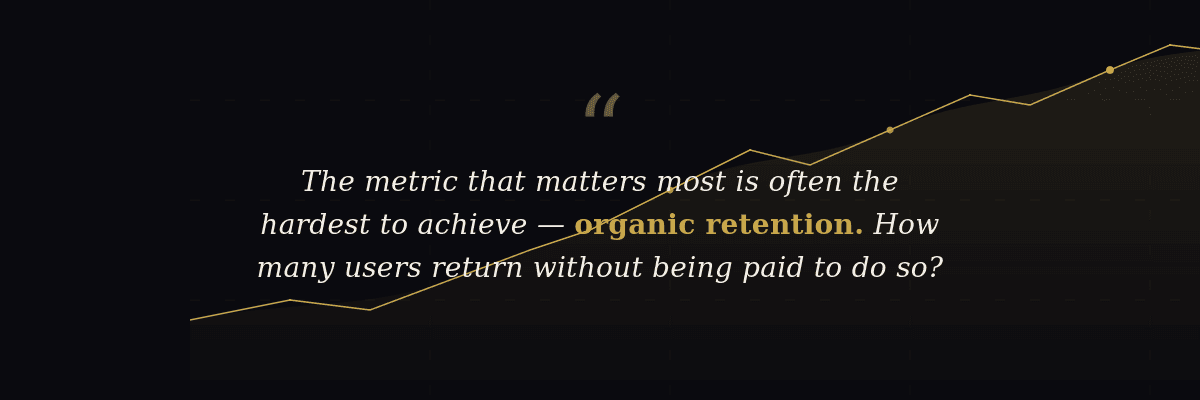
The metric that matters most is often one of the hardest to achieve: organic retention.
How many users return to a platform without being paid to do so? How many wallets remain active several months after onboarding? How much activity comes from users who genuinely value the product rather than capital-seeking short-term opportunities?
These questions are becoming increasingly important as institutional investors apply more rigorous evaluation frameworks to digital asset businesses. The focus is gradually shifting away from headline growth metrics and toward indicators that resemble traditional business fundamentals, including user retention, protocol revenue, sustainable fee generation, and long-term engagement.
For founders, the lesson is straightforward. Metrics should be used to understand product health, not to create an illusion of progress. Sustainable businesses are built on users who continue to participate long after incentives have disappeared.

Tokenomics and Execution Are the Real Moats
One of the most important lessons crypto teaches is that tokenomics is not separate from product strategy. It is product strategy.
Token distribution influences who benefits from growth, how communities behave, how governance evolves, and whether future users view participation as worthwhile. Incentives shape behaviour, and behaviour ultimately determines outcomes.
When economic structures disproportionately reward early participants while creating limited value for future users, the consequences eventually emerge. Community trust weakens, governance becomes concentrated, and long-term engagement declines. The technology itself may function perfectly, but poor incentive alignment can undermine the entire ecosystem.
This is why token design remains one of the most complex challenges facing digital asset founders. Sustainable growth requires balancing the interests of users, contributors, investors, and the protocol itself over extended periods of time.
At the same time, crypto operates in an environment where competitive advantages are difficult to protect.
Most successful protocols are open source. Features can be analysed publicly, copied quickly, and deployed by competitors within weeks. Unlike traditional technology sectors, where patents and proprietary systems create barriers to entry, digital asset markets reward organisations that execute faster than everyone else.
The question is no longer whether a company can build something competitors cannot replicate. The question is whether it can learn, iterate, and improve faster than competitors can copy what already exists.
The strongest teams combine operational speed with deep customer understanding. They use user feedback, market signals, behavioural data, and community insight to make better decisions and ship improvements continuously.
Taken together, these lessons point to a broader shift that extends beyond crypto itself. Markets are becoming more transparent. Switching costs are declining. Users have more choice than ever before. The companies that succeed in this environment will not be those protected by friction. They will be those capable of earning trust, aligning incentives, understanding their customers, and executing faster than their competitors.
Key Takeaways
Customer loyalty in crypto must be earned continuously because switching costs are minimal.
Organic retention is a stronger indicator of product-market fit than TVL, wallet counts, or incentive-driven growth.
Tokenomics should be treated as a core product design function rather than a fundraising mechanism.
Open-source infrastructure makes execution speed and user understanding the primary competitive advantages.
The lessons emerging from digital asset markets increasingly apply across broader technology and financial sectors.